
The Historic Armstrong Brick Block, 1890 - present day
Johnsonburg, Pennsylvania
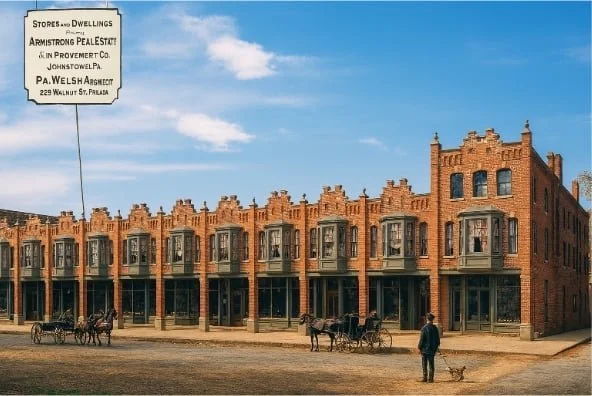
Standing along the 500 block of Market Street in the heart of Johnsonburg’s Commercial Historic District is a building that has witnessed more than 136 years of our community’s story.
The Armstrong Brick Block, established in 1890, is a remarkable 45,000-square-foot complex of 12 connected brick structures, built three bricks thick and extending nearly an entire downtown block. Its first-floor storefronts, upper-story business and residential spaces, distinctive bay windows, sandstone details, parapets, and long covered arcade make it one of Johnsonburg’s most recognizable architectural landmarks.
It is also much more than an old building.
The Brick Block was created during the period when Johnsonburg was rapidly transforming from a small settlement along the Clarion River into a thriving industrial community. For generations, people have shopped here, worked here, lived above its storefronts, collected their mail here, met friends here, eaten here, and conducted business here.
Today, the Armstrong Brick Block is once again becoming what it was created to be: a place filled with people, businesses, activity and possibility.
BUILT DURING JOHNSONBURG'S BOOM
The story of the Armstrong Brick Block is inseparable from the story of brothers Meylert and Lewis Armstrong.
The Armstrong brothers were papermakers who recognized the extraordinary industrial potential of Johnsonburg: abundant timber, plentiful water at the confluence of the East and West Branches of the Clarion River, natural gas, clay deposits, and increasingly important railroad connections.
In 1888, the brothers incorporated the Clarion Pulp and Paper Company with plans to establish a major paper-manufacturing operation in Johnsonburg.
But they were not simply constructing a mill.
As industry expanded, workers, families, merchants and investors would be needed. Johnsonburg needed housing, stores, offices and the infrastructure of a growing community. The Armstrong interests became instrumental in shaping much of the town that developed around the paper industry.
The Armstrong Real Estate & Improvement Company was established as part of that effort.
And along Market Street, an ambitious commercial development began to rise.
THE ARCADE BUILDING
The structure we now affectionately call the Brick Block was originally known as the Arcade Building.
The name referred to one of its most distinctive architectural features: the long, sheltered walkway beneath the projecting upper floors that provided pedestrians access to the adjoining storefronts.
Designed by Philadelphia architect P. A. Welsh, the enormous commercial block incorporated a repeating series of two-story storefront bays, with taller three-story "bookends" giving the long structure an especially impressive profile.
Its construction represented the optimism surrounding Johnsonburg during the closing years of the nineteenth century.
A July 29, 1891 newspaper account described a row of 12 large business rooms built into one huge block, two and three stories high, noting the liberal use of brick, stone facing, copings and decoration.
The writer considered the completed building something virtually any community would be proud to possess.
More than 135 years later, we agree.
AN EARLY SHOPPING COMPLEX
The Armstrong Brick Block can reasonably be considered an early predecessor of the modern shopping center.
Rather than individual commercial buildings scattered along the street, its multiple adjoining storefronts were intentionally incorporated into one enormous continuous structure, all accessible beneath the covered arcade.
That concept was remarkably forward-thinking for a small Pennsylvania community in 1890.
The building was not simply a row of stores. It was a coordinated commercial destination.
The first documented tenant was E. F. Cummings & Company, which moved into its new Armstrong Block offices in August 1891. Edward Francis Cummings had recently retired from railroad work and established an office associated with the Adams Express Company while conducting other business, including insurance.
Another important early occupant soon followed.
The United States Post Office occupied the southernmost storefront at 569 Market Street, at the corner of Market and Bridge Streets.
At a time before widespread home mail delivery, residents had to visit the post office to purchase stamps, send packages and collect their mail. That constant flow of people made the post office something we would recognize today as an anchor tenant—bringing customers past the neighboring shops and offices along the arcade.
Remarkably, that same corner storefront is today the home of the Heritage–Education & Welcome Center and the Johnsonburg Community Trust.
History has come full circle.
GENERATIONS OF STOREFRONTS
Over the decades, the storefronts of the Brick Block continually changed to meet the needs of the community.
Businesses came and went. Owners changed. Storefronts were remodeled. Families operated shops that became part of everyday Johnsonburg life.
Among the businesses remembered within the Brick Block are clothing shops, restaurants, beauty shops, professional offices, service businesses and neighborhood gathering places.
At 569 Market Street alone, the former post office space would eventually become home to businesses including Lund Clothing, Morris Clothing, Maree's Style Center, Anna B. Shoppe, GlorB Shoppe, Bloam's Radio Sales and Service, Widmann Discount Store, The Cherry Tree and Panda Restaurant before beginning its newest chapter as the Heritage–Education & Welcome Center.
Names such as Pelp's Restaurant, the Anna B. Shoppe, Rich and Grace Hair Salon and the Johnsonburg News Stand remain woven into the memories of generations of Johnsonburg residents and alumni.
The history of the Brick Block isn't simply architectural history.
It is people history.
Every storefront holds stories.
PART OF A NATIONAL REGISTER HISTORIC DISTRICT
The Armstrong Brick Block is one of the most significant structures within the Johnsonburg Commercial Historic District, which was officially listed on the National Register of Historic Places in 1999.
The district encompasses approximately six acres of Johnsonburg's historic central business district and represents the extraordinary period of growth that transformed the community during the late nineteenth and early twentieth centuries.
The National Register documentation specifically recognizes the Armstrong Real Estate and Improvement Company's massive commercial block at 523–569 Market Street and identifies architect P. A. Welsh as its designer.
The Brick Block alone represents approximately one-quarter of Johnsonburg's Commercial Historic District.
Losing it would mean losing an enormous piece of the architectural fabric that makes downtown Johnsonburg historically significant.
That fact would become critically important in 2020.
A BUILDING IN DANGER
Like many historic commercial districts across rural America, downtown Johnsonburg changed dramatically during the twentieth century.
Shopping habits changed. Businesses closed or relocated. Buildings aged. Maintenance became increasingly difficult and expensive.
The Armstrong Brick Block survived—but survival and preservation are not the same thing.
By the twenty-first century, portions of the enormous structure had deteriorated considerably. Vacant spaces contained years of accumulated debris. Roofs, windows, utilities, floors, structural components and storefronts required attention.
For a building 45,000 square feet, the scale of the problem was intimidating.
There was also a larger question:
What would happen to Johnsonburg's Commercial Historic District if one-quarter of it disappeared?
2020: THE JOHNSONBURG COMMUNITY TRUST STEPS IN
In June 2020, the Johnsonburg Community Trust took an unprecedented step.
For the first time in the nonprofit organization's history, the Trust acquired real estate.
And it wasn't a small project.
It was the Armstrong Brick Block.
The building was acquired through the repository process because the Trust understood what was at stake. Allowing the 12-structure complex to continue deteriorating or ultimately be demolished would leave an enormous hole in Market Street and permanently alter the character of the historic district.
The Trust decided the building was worth saving.
Then the real work began.
55 TONS AND A BEGINNING
The earliest group of volunteers entered spaces filled with decades of accumulated material and deterioration.
They began hauling.
And hauling.
And hauling.
Those first volunteers removed approximately 55 tons of debris while working to make the structure weather-tight and stabilize what they could.
There was no hired executive director overseeing a multimillion-dollar redevelopment project.
There was a nonprofit board, community volunteers, partners, donors and people willing to get dirty because they believed the building and Johnsonburg deserved another chance.
Those first months established the philosophy that continues to guide the project:
Historic buildings don't save themselves. People do.
THE TUESDAY CREW
Eventually, an extraordinary volunteer force emerged.
They became known simply as the Tuesday Crew.
Every Tuesday, retired teachers, tradespeople, craftspeople, business owners and community members arrive at the Armstrong Brick Block and go to work.
Their work has included demolition, framing, electrical work, plumbing, heating, insulation, window preparation and installation, painting, trim, flooring, storefront rehabilitation, historic lighting, exhibit construction, cleaning, hauling and countless jobs that don't fit neatly into a description.
Since the original cleanup, the Tuesday Crew has removed more than 80 additional tons of material from the structure while contributing thousands upon thousands of volunteer hours.
They aren't merely repairing an old building.
They are rebuilding pieces of their hometown.
PRESERVATION, NOT ERASURE
Restoring the Armstrong Brick Block has never meant making a 136-year-old building look new.
The goal is to allow it to remain historic while making it useful again.
That distinction matters.
Original architectural features are retained whenever possible. Historic openings are respected. Materials are repaired, reused and interpreted. Modern systems are incorporated without unnecessarily erasing evidence of the building's past.
Even the antique lighting beneath the Brick Block's cantilevered arcade has been carefully sourced and brought back to life through rewiring and repainting, preserving a detail from a historic structure in St. Marys, PA.
The result isn't supposed to be perfect.
It's supposed to be authentic to the period.
HISTORIC WINDOWS & ENERGY EFFICIENCY
One of the greatest challenges in preserving a nineteenth-century commercial structure is making it economically sustainable for twenty-first-century use.
Historic preservation and energy efficiency therefore work hand in hand at the Armstrong Brick Block.
The West Penn Energy Fund, formerly the West Penn Power Sustainable Energy Fund, has become an extraordinary partner in that effort.
Among its investments is $155,000 toward energy improvements and historically appropriate replacement windows.
Rather than simply installing standard rectangular replacement windows and filling the distinctive curved openings above them, custom windows have been manufactured by Ventana USA in Export, Pennsylvania, allowing the architectural character of the building to remain visible.
Energy work has also incorporated modern insulation, air sealing and building-performance testing while respecting the historic structure.
The philosophy is simple:
Saving a historic building also means making it sustainable enough to survive another century.
THE FIRST NEW CHAPTER: HERITAGE–EDUCATION & WELCOME CENTER
One of the most important milestones came in July 2024 with completion of the Heritage–Education & Welcome Center at 569 Market Street.
The very storefront that once housed Johnsonburg's early United States Post Office again became a community destination.
The HEWC serves as the home of the Johnsonburg Community Trust while functioning as a gathering place for:
local and regional history
changing heritage exhibits
classes and workshops
visitor information
local artisan work
Pennsylvania Wilds and regional merchandise
community programming
tours of the Armstrong Brick Block and Johnsonburg Commercial Historic District
Instead of simply preserving the building, the Trust began using the building to teach people why places like it matter.
BUSINESSES RETURN TO THE BRICK BLOCK
Restoration has always had an economic-development purpose as well as a preservation purpose.
The goal isn't to create a museum occupying 45,000 square feet.
The goal is to make the Brick Block alive again.
Following completion of the HEWC, Kay & Rose Bakery became the first new business to return to the rehabilitated Brick Block, celebrating its grand opening in October 2024.
In March 2026, Sugarcane Floral Design & Gifts opened another restored storefront.
In July 2026, Clarion River Outdoors LLC opened its doors, creating a business centered on the Clarion River, outdoor recreation, travel planning and the Pennsylvania Wilds.
Each opening represents far more than another occupied storefront.
Every one puts lights back in a window.
Every one brings people beneath the arcade.
Every one returns economic activity to a building specifically constructed for that purpose more than a century ago.
WHAT COMES NEXT
Much of the Armstrong Brick Block remains a work in progress.
And that's part of its story.
Plans for additional spaces include the rehabilitation of the upper floors above the Heritage–Education & Welcome Center for short-term lodging, providing visitors an opportunity to stay within the historic structure.
Units 4 and 5 the former bank space with its original vault are envisioned as a heritage, maker and business-incubator space interpreting industries and traditions that shaped Johnsonburg and the region, including lumber, papermaking, brickmaking, railroads, river history, architecture, arts and traditional trades.
Additional spaces are being considered for new retail, food and community-oriented uses, including a future boutique restaurant concept developed with Penn State partners.
Unit 10 is envisioned as a permanent home for the Tuesday Crew and trades training, creating a place where the skills being used to save the Brick Block can be shared with another generation.
The project is preservation, economic development, education and community building happening simultaneously.
THE CHALLENGE BEHIND THE BUILDING
The rehabilitation has also revealed the realities of preserving a structure of this scale.
A deteriorating historic sandstone retaining wall behind portions of the Brick Block has become one of the Trust's most urgent infrastructure priorities.
Repairing the wall and addressing drainage is necessary not simply for the wall itself, but to protect restored and future units and allow rehabilitation to continue safely.
Whenever possible, the Trust intends to retain and reuse the original sandstone.
The challenge is another reminder that historic preservation rarely happens one storefront at a time. Roofs, foundations, drainage, masonry, utilities, energy systems and infrastructure all have to work together if the building is going to survive.
A COMMUNITY INVESTMENT
No single person, organization or grant has saved the Armstrong Brick Block.
Its rehabilitation has been possible because of a growing network of people and organizations willing to invest in the idea that Johnsonburg's historic downtown is worth preserving.
That support has included the West Penn Energy Fund, Pennsylvania Department of Community & Economic Development, Johnsonburg Borough, PA Wilds, Pennsylvania Great Outdoors, Stackpole-Hall Foundation, local businesses, private donors, foundations, volunteers and community partners.
Individual gifts have ranged from major project funding to donated building materials, meals for volunteers, professional expertise and a few hours of someone's time.
All of it matters.
Preservation at this scale is cumulative.
One window. One wall. One storefront. One Tuesday. One volunteer. One donor at a time.
RECOGNITION BEYOND JOHNSONBURG
The Armstrong Brick Block's revival is increasingly being recognized beyond the community.
The Johnsonburg Community Trust received the West Penn Energy Fund Power & Foresight Award in 2025, recognizing the partnership between historic preservation and sustainable building practices.
In 2026, the Armstrong Brick Block received the PA Wilds Great Places Award, recognizing it as a significant destination within the Pennsylvania Wilds.
These honors belong not simply to a building.
They recognize the people who refused to give up on it.
MORE THAN A BUILDING
The Armstrong Brick Block has survived industrial booms, changing businesses, generations of families, economic downturns, weather, vacancy and more than a century of change.
Its current restoration isn't an attempt to return Johnsonburg to 1890.
It is an effort to take something extraordinary that survived from 1890 and give it purpose in 2026 and beyond.
That is what preservation can do.
The Armstrong brothers built a commercial block because they believed Johnsonburg had a future.
More than 136 years later, the Johnsonburg Community Trust, Tuesday Crew, donors, partners, businesses and community are investing in the Brick Block for exactly the same reason.
We believe Johnsonburg has a future, too.
And beneath that old arcade, behind those brick walls and curved windows, the next chapter is already being written.
THE ARMSTRONG BRICK BLOCK AT A GLANCE
Established: 1890
Opened for business: 1891
Original name: Arcade Building
Historic name: Armstrong Real Estate & Improvement Company commercial block
Address: 523–569 Market Street, Johnsonburg, Pennsylvania
Size: Approximately 45,000 square feet
Configuration: 12 connected structures with first-floor commercial spaces, upper floors and basements
Architect: P. A. Welsh of Philadelphia
Architectural character: Late nineteenth-century commercial architecture with brick construction, stone detailing, projecting upper stories, bay windows, decorative parapets and a continuous covered arcade
Historic District: Johnsonburg Commercial Historic District, listed on the National Register of Historic Places in 1999
Acquired by Johnsonburg Community Trust: June 2020
Current role: Historic preservation, economic development, heritage education, tourism, retail, community gathering and adaptive reuse
Home of: Heritage–Education & Welcome Center and Johnsonburg Community Trust
Volunteer restoration force: The Tuesday Crew
Our Work Continues
The Armstrong Brick Block is being restored one space at a time.
There are still windows to restore, upper floors to rehabilitate, storefronts to fill, infrastructure to repair and thousands of hours of work ahead.
The story isn't finished.
You can become part of it through the Johnsonburg Community Trust's 1890 Project, by volunteering, supporting the Tuesday Crew, donating to the restoration or simply visiting the Brick Block and supporting the businesses bringing Market Street back to life.
Historic buildings don't save themselves. People do.